


What Builders Must Know
ServiceNow provides a versatile scripting mannequin that permits builders to customise utility conduct, management person interplay, and implement enterprise logic. These capabilities are particularly necessary in ServiceNow managed services, the place maintainability and efficiency straight affect long-term platform success. Two core parts of this mannequin are client-side scripting and server-side scripting.
Though each depend on JavaScript, they execute in several environments and serve essentially totally different functions. Understanding this distinction is essential for designing purposes that stay responsive, dependable, safe, and maintainable.
Earlier than evaluating their tradeoffs, it is very important perceive how every scripting layer operates.
What’s client-side scripting?
Consumer-side scripting refers to JavaScript that executes within the person’s browser. These scripts run when customers work together with the ServiceNow interface, akin to when a kind hundreds, a area worth adjustments, or a report is submitted.
As a result of consumer scripts execute regionally, they supply rapid suggestions with out requiring a server round-trip. This makes them important for constructing dynamic and interactive person experiences.
Consumer-side scripts are generally used to validate enter, management area visibility, set obligatory circumstances, auto-populate values, and show contextual messages. For instance, choosing a particular class can immediately reveal related fields, enhancing usability and guiding knowledge entry.
Nonetheless, consumer scripts function strictly inside the seen UI design. They don’t execute when information are created or up to date by way of REST APIs, imports, scheduled jobs, or background scripts. In consequence, client-side logic can’t be relied upon for imposing guidelines that should apply system-wide.
Instance:
Consumer Script (onSubmit Validation)
perform onSubmit() {
var precedence = g_form.getValue(‘precedence’);
if (precedence == ‘1’) {
var justification = g_form.getValue(‘u_justification’);
if (!justification) {
g_form.showFieldMsg(‘u_justification’,
‘Justification is required for Essential precedence’,
‘error’);
return false;
}
}
return true;
}
What’s server-side scripting?
Server-side scripting refers to JavaScript that executes inside the ServiceNow occasion itself. These scripts run independently of the browser and are triggered by database operations, workflows, scheduled processes, and integrations.
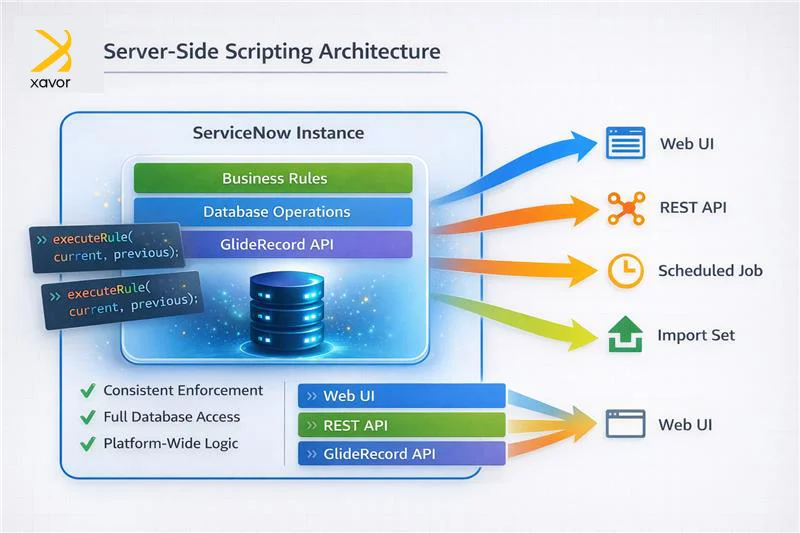
Since server scripts execute near the information layer, they’ve full entry to platform APIs akin to GlideRecord and GlideAggregate. This makes them chargeable for imposing enterprise logic, validating information, performing database operations, and sustaining system integrity.
Server-side scripts guarantee constant conduct no matter how knowledge enters the system. Whether or not information originate from the UI, APIs, imports, or AI automation, server logic executes reliably.
Due to this authority, server-side scripting governs guidelines that should at all times apply, together with knowledge validation, lifecycle administration, automation, and safety enforcement.
Instance:
Enterprise Rule (Server-Facet Enforcement)
(perform executeRule(present, earlier) {
if (present.precedence == 1 && gs.nil(present.u_justification)) {
gs.addErrorMessage(‘Justification is required for Essential precedence’);
present.setAbortAction(true);
}
})(present, earlier);
Key variations: Consumer-side vs. server-side scripting
Consumer-side and server-side scripting differ primarily in the place they run and what they do.
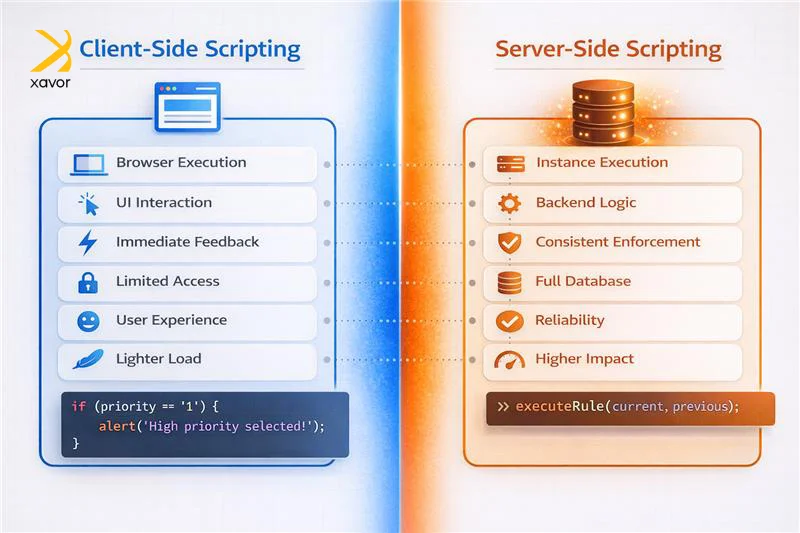
- Execution context: The first distinction between client-side and server-side scripting lies in execution context.
- Focus and obligations: Consumer scripts run within the browser and concentrate on interplay and responsiveness. Server scripts run on the occasion and concentrate on enforcement and consistency.
- Consumer Expertise vs reliability: Consumer-side logic enhances the person expertise by offering rapid suggestions. Server-side logic ensures correctness and reliability throughout all entry factors.
- Knowledge entry: Consumer scripts have restricted entry to knowledge and can’t straight modify the database. Server scripts have full database entry and may carry out CRUD actions.
- Efficiency affect: Consumer scripts usually have a lighter footprint as a result of they don’t depend on steady server communication. Server scripts can enhance system load relying on how advanced the backend operations are.
- Actual-time suggestions: Consumer scripts can replace the interface instantly and supply real-time responses. Server scripts often don’t change the UI straight away since they concentrate on backend processing.
- Safety: Consumer scripts are usually restricted to UI-level adjustments and carry fewer safety issues. Server scripts typically work with delicate knowledge and require stronger protections, together with strict entry management and validation.
| Facet | Consumer-side Scripting | Server-side Scripting |
| Execution context | Runs within the person’s browser | Runs on the server/occasion |
| Focus and obligations | UI interplay and responsiveness | Enforcement, consistency, and backend logic |
| UX vs reliability | Quick suggestions and higher person expertise | Correctness and reliability throughout all entry factors |
| Knowledge entry | Restricted knowledge entry, no direct DB adjustments | Full DB entry, can carry out CRUD |
| Efficiency affect | Often lighter, fewer server calls | Can add load based mostly on operation complexity |
| Actual-time suggestions | Updates UI immediately | Doesn’t replace UI instantly, backend-focused |
| Safety | Largely UI-level issues | Handles delicate knowledge, requires stronger controls |
Consumer-side strengths and limitations
Consumer-side scripting performs a essential position in delivering a clean and responsive interface.
It’s notably efficient for:
- Validating enter earlier than submission
- Dynamically updating kind conduct
- Decreasing pointless server calls
- Guiding person actions
By offering rapid suggestions, consumer scripts assist stop avoidable errors and scale back friction throughout knowledge entry.
Nonetheless, client-side scripting has clear limitations.
Extreme consumer logic can negatively have an effect on kind efficiency. Heavy onLoad scripts or a number of asynchronous calls might delay rendering and degrade responsiveness.
Extra importantly, consumer scripts can’t be handled as authoritative enforcement. As a result of they run within the browser:
- Customers might bypass or disable them
- Integrations don’t set off them
- Background processes ignore them
For these causes, client-side validation must be handled as an early checkpoint, not a safeguard.
Server-side strengths and dangers
Server-side scripting governs platform-level conduct and carries enforcement accountability.
It’s important for:
- Enterprise guidelines
- Knowledge validation
- Document processing
- Automation
- Safety enforcement
As a result of server scripts execute no matter how knowledge enters the system, they guarantee constant and dependable utility conduct.
That authority, nonetheless, introduces a broader affect.
Poorly designed server logic, akin to inefficient queries, recursive triggers, or pointless updates, can enhance transaction time and degrade instance-wide efficiency.
Not like client-side inefficiencies, which generally have an effect on a single person session, server-side inefficiencies can affect your entire platform.
Robust server-side design due to this fact requires each technical functionality and cautious restraint.
Safety as a choice driver
Safety necessities ceaselessly make clear the place logic ought to be executed.
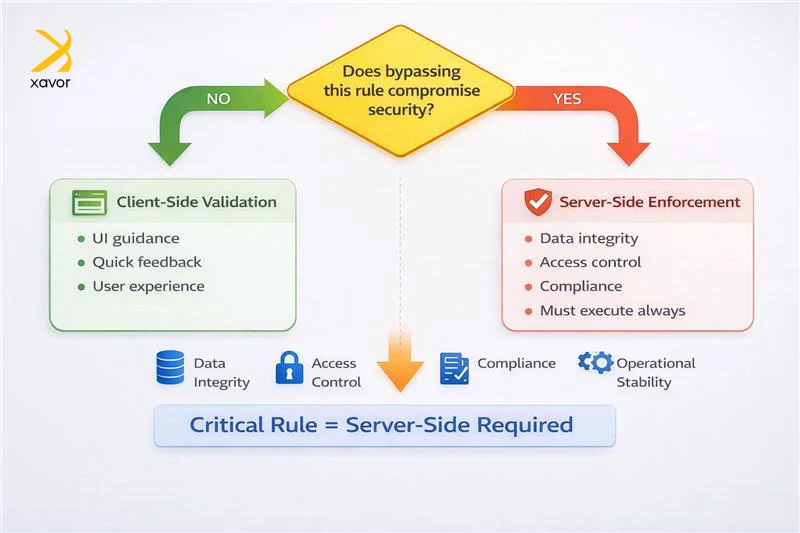
If bypassing a rule might compromise:
that logic should execute server-side.
Consumer scripts can information conduct and enhance usability, however delicate guidelines ought to by no means depend on browser-side enforcement alone.
This distinction turns into particularly necessary in enterprise environments the place integrations and automatic processes generate information with out person interplay.
Why each layers matter
Robust ServiceNow options rely upon utilizing each client-side and server-side scripting collectively. Every layer has a definite position and combining them creates a smoother person expertise with out compromising knowledge high quality.
Consumer scripts enhance usability by validating inputs immediately, guiding customers, and decreasing errors earlier than a kind is submitted. This makes the interface really feel quicker and extra responsive, and it helps stop frequent errors early.
Server scripts shield the platform by imposing the identical guidelines within the backend, regardless of how the information is created or up to date. Whether or not a report is modified by way of the UI, an import, an API name, a background course of, or integration solutions, server-side logic ensures the proper conduct each time.
This layered validation just isn’t redundancy. It’s a deliberate architectural follow that separates person expertise issues from system enforcement. Options constructed with this strategy are extra constant, simpler to troubleshoot, and less complicated to preserve as the appliance grows.
Conclusion
Nice ServiceNow improvement will depend on readability and intention. When logic is positioned in the fitting layer, the platform behaves persistently in actual eventualities. That consistency helps customers throughout day by day work and helps builders launch adjustments with confidence. It additionally protects knowledge integrity by guaranteeing necessary guidelines apply regardless of how information enter the system.
As purposes develop, this self-discipline turns into much more necessary. Integrations introduce new entry factors and automation will increase report exercise. Edge instances floor quicker, and weak boundaries create extra help overhead. When obligations keep nicely separated, troubleshooting turns into calmer and extra direct. The result’s an answer folks can rely on and a codebase groups can develop with out stress.
If you need assist designing ServiceNow options which are scalable, safe, and supportable, Xavor can assist. Our staff works with organizations to use robust scripting patterns, enhance efficiency, and strengthen governance throughout the platform. Attain out at [email protected].
Concerning the Creator

Umair Falak is the search engine optimization Lead at Xavor Company, driving natural progress by way of data-driven search methods and high-impact content material optimization. With hands-on expertise in technical search engine optimization and efficiency analytics, he turns search insights into measurable enterprise outcomes.
FAQs
No, consumer scripts enhance the kind expertise, however they solely run within the UI. Data created by way of APIs, imports, scheduled jobs, or background processes can bypass consumer logic, so essential validation have to be enforced server-side.
When the rule should at all times apply. Something tied to knowledge integrity, entry management, compliance, lifecycle enforcement, or platform-wide correctness ought to run on the server so it really works persistently throughout all entry factors.
On the consumer aspect, heavy onLoad logic and too many calls can gradual kinds. On the server aspect, inefficient queries, pointless updates, recursion, or overly advanced enterprise guidelines can enhance transaction time and affect the entire occasion.
Source link
latest video

latest pick



news via inbox
Nulla turp dis cursus. Integer liberos euismod pretium faucibua



