


Raise and shift off Agile PLM: A profitable migration technique
IT or software program migrations are enterprise as ordinary for firms. Outdated platforms retire, and companies must shift to newer, extra superior choices. Nevertheless, they’re by no means straightforward, each technically and culturally. Agile PLM customers are nicely conscious that point is upon them because the veteran PLM platform will attain its end-of-life on 31 December 2027.
The raise and shift technique makes information migration lots much less intimidating. Data migration services use it to maneuver a whole software from one surroundings to a different with minimal adjustments. Raise and shift is just about like hiring a transferring firm when you’re switching houses. Simply choose all of your stuff and place it some place else.
On this weblog, we’ll clarify how one can raise and shift from Agile PLM to fashionable PLM platforms simply and shortly earlier than the deadline.
What’s subsequent for Oracle Agile PLM customers?
Oracle Agile PLM has been a foundational system for manufacturing advanced merchandise. For over 20 years, it remained the #1 PLM software for managing product information and engineering change. Nevertheless it’s time is coming to an finish as Oracle has determined to retire the platform. 9.3.6 is the final model, and assist for the product will finish subsequent 12 months.
Subsequently, for Agile customers, a pivot to fashionable PLM platforms is essential. Sticking with Agile poses safety dangers, and it now not matches its identify as an “agile” platform. It would decelerate your workflows to your individual detriment.
So, what’s the subsequent step for Agile customers? That relies on your wants, however Aras Innovator and Propel are two nice platforms to hold on your PLM journey. They incorporate the strengths of Agile and likewise supply superior cloud capabilities that you just gained’t discover in the legacy platform.
However you want a information migration technique, like raise and shift, to correctly switch all of your information from Agile to those platforms with none loss or harm.
What’s lift-and-shift migration?
Raise and shift is an information migration technique the place an actual copy of an software is moved from one IT surroundings to a different. Often, it’s from an on-premises setup to cloud platforms.

It’s also referred to as rehosting and is usually the quickest solution to transfer to the cloud as a result of it takes much less time than rebuilding every little thing. Concomitantly, raise and shift additionally requires much less labor and value than different information migration choices.
In apply which means:
- Minimal code adjustments
- Protect current structure
- Rehost workloads as-is
Raise and shift is a preferred selection for large-scale migrations. Its magnificence is in its simplicity whereas coping with an online of interdependencies and information sources. Nevertheless, understand that it isn’t one of the best default selection for each software.
Ideally, raise and shift works greatest when the workload is already pretty appropriate with the cloud, corresponding to containers or microservices. You may as well use it as a brief first transfer, the place you migrate the appliance now and enhance or redesign it later within the cloud.
Utilizing raise and shift for Agile PLM migration
Some folks don’t suppose raise and shift is the precise method for PLM migration. And to be sincere, they’ve legitimate issues. Nevertheless, they’re solely true for some PLM migrations. Its success or failure relies upon largely on your aims and supply information.
PLM information migration dangers of raise and shift
The very first thing it’s worthwhile to find out about PLM information is that it’s very messy. Every part associated to product improvement is constructed round information. You will have suppliers, elements, revisions, BOMs, paperwork, and a ton of different issues interconnected.

Subsequently, PLM information migration can not occur in isolation. If these dependencies are broken or damaged throughout migration, the product construction gained’t work in your supposed PLM software program.
Now, newer PLM programs typically anticipate or demand cleaner, extra standardized information. This at first makes raise and shift difficult for PLM migration as a result of transferring information “as is” creates some issues:
- Information fails to load as a result of it doesn’t meet the goal system’s guidelines
- It masses in a poor-quality kind that makes it exhausting to belief or use
Making raise and shift work for PLM platforms
You can’t simply dismiss raise and shift for PLM data migration due to these dangers. These are operational roadblocks that may be resolved with the precise method. Raise and shift works nice for PLM migrations whether it is moved with sufficient cleaning, standardization, and validation to make it usable within the new system.
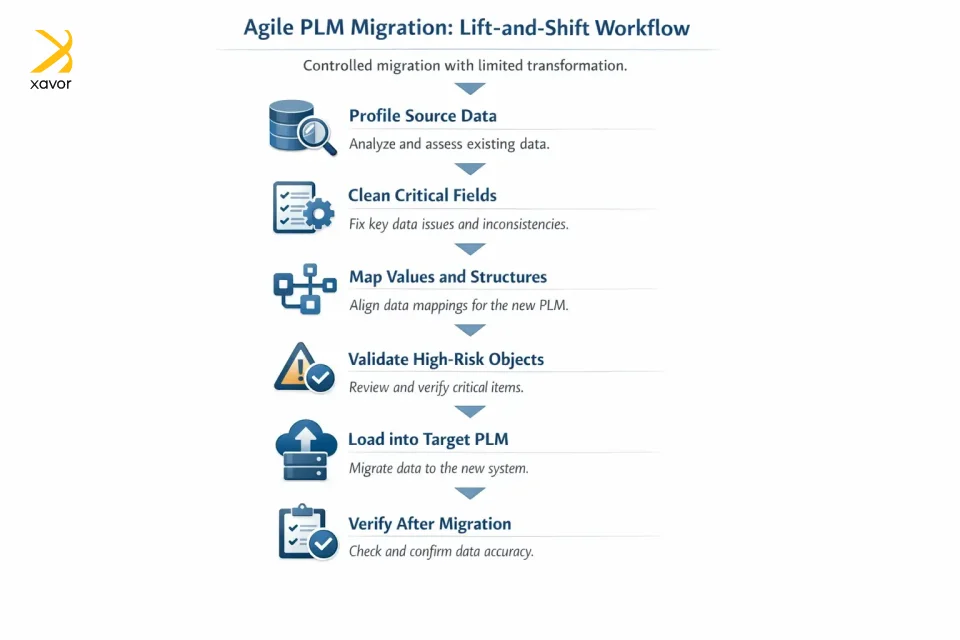
Right here’s how we method raise and shift for Agile PLM migration:
1. Information high quality is paramount
In case your legacy PLM information is inconsistent, the foundation drawback is the information high quality, not raise and shift by itself. A lift-and-shift method can nonetheless succeed while you guarantee these items are accounted for:
- The supply PLM occasion already has sturdy governance
- Required attributes are largely populated
- Classifications are managed
- The goal system is configured to simply accept equal constructions
So, raise and shift for PLM migrations solely fails when poor-quality information is moved with out preparation.
2. Don’t copy blindly
The truth that raise and shift requires minimal transformation doesn’t imply every little thing is copied with out validation. Mapping of code values, cleaning of essential fields, pre-load profiling, and validation for high-risk objects continues to be raise and shift in spirit.
Subsequently, permits groups to do fundamental mapping, focused cleaning, and risk-based validation so the migrated information can load efficiently and stay usable, with out turning the venture right into a full redesign or transformation effort.
3. Configure the goal system
Generally, it truly is inconceivable to make your legacy PLM information work with the goal system’s guidelines. However fashionable PLM options like Aras or Propel are fairly versatile, so you may tweak round.
You possibly can configure their platforms to assist transition and information migration. For instance, Aras helps Extended Classification, which lets groups assign properties based mostly on classification and evolve classification constructions with out modifying core merchandise varieties each time.
That may assist throughout migration by preserving legacy distinctions in mapped fields first, then tightening standardization later.
4. Prioritize essential information
Not all PLM information wants the identical stage of cleanup or care. Some information is used day by day, so it has to be clear and dependable. Different information is outdated and is barely stored for reference, historical past, or audit functions.
For instance, legacy paperwork could solely want retrieval accuracy. That’s the reason a lift-and-shift method could also be completely acceptable for low-change, historic, or archive-oriented datasets. That also counts as a profitable PLM migration for these domains.
5. Keep away from strict standardization
There may be nothing mistaken with cleaning and standardizing information earlier than migration. However it’s not all the time one of the best path. Heavy pre-migration transformation has its downsides, corresponding to:
- Lengthened timelines
- Elevated enterprise disruption
- Mapping errors
- Delayed retirement of legacy programs
In some conditions, transferring the information first and bettering it within the goal system is truly safer and quicker.
Conclusion
The talk round raise and shift in PLM migration typically will get framed as a easy yes-or-no choice. In actuality, it is neither a silver bullet nor a flawed technique. Its success relies on how thoughtfully it’s utilized. When organizations deal with raise and shift as a disciplined migration method, it may turn out to be a sensible solution to transfer ahead with out turning migration right into a multi-year transformation venture.
For Agile PLM customers going through the end-of-life deadline, the actual problem is deciding how a lot change is really vital for the time being of migration.
If you’re planning your transition from Agile PLM, don’t wait till the deadline forces troublesome selections. Xavor understands each the technical and operational realities of PLM migration. Our PLM consultants have in-depth expertise of utilizing PLM platforms like Agile, Aras, and Propel to speed up your Agile PLM transition. We are able to migrate advanced product information safely to fashionable platforms utilizing confirmed methods that stability velocity, accuracy, and long-term worth.
Contact us at [email protected] to plan out a migration technique that retains your engineering groups productive and your information working for you.
Concerning the Creator

Umair Falak is the web optimization Lead at Xavor Company, driving natural progress by data-driven search methods and high-impact content material optimization. With hands-on expertise in technical web optimization and efficiency analytics, he turns search insights into measurable enterprise outcomes.
FAQs
A typical instance of raise and shift is transferring an on-premises software from an organization’s personal servers to cloud-based digital machines with minimal adjustments. In a PLM context, it may imply transferring an Agile PLM occasion and its information to a brand new hosted surroundings first, then optimizing or redesigning it later.
Raise and shift timelines fluctuate based mostly on the dimensions of the system, information high quality, integrations, and the way a lot validation is required. A easy migration could take just a few weeks, whereas a posh enterprise migration can take a number of months.
Use raise and shift when it’s worthwhile to transfer shortly to a brand new surroundings with minimal disruption, particularly for programs which can be already pretty appropriate with the goal platform. It’s also an excellent choice when enterprise continuity issues greater than quick redesign, or as a primary step earlier than later optimization.
Source link
latest video

latest pick



news via inbox
Nulla turp dis cursus. Integer liberos euismod pretium faucibua



