


Mumbai’s demographic mutation has political dimensions
The BMC elections on 15 January, 2026 will probably be an important check for the Thackeray legacy in Mumbai, the place the Shiv Sena dominated civic politics for 25 years at a stretch. However the metropolis’s altering demographics and economic system have had a far reaching impact on its voting sample.
This 12 months, the competition has taken on new dimensions. The principal contenders are the ruling Mahayuti alliance, comprising the Eknath Shinde–led breakaway Sena faction and the BJP, whose seat-sharing negotiations have threatened to complicate the competition, and a re-energised opposition bloc led by Uddhav Thackeray’s Sena and Raj Thackeray’s Maharashtra Navnirman Sena. A diminished pressure within the metropolis, the Thackerays are campaigning on a shared ‘Marathi manoos’ plank to consolidate regional assist.
“At one level, Shiv Sena represented the aspirations of a sure linguistic group of individuals, however their quantity goes down, and alternatively, you will have one other get together catering to related aspirations, regardless of the linguistic composition, right this moment,” mentioned Uttara Sahasrabuddhe, a former professor at Mumbai College.
The Congress, in the meantime, is struggling to realize traction. Crippled by infighting inside its native items, it’s set to contest the elections independently. Regardless of being a part of the Maha Vikas Aghadi, it’s taking over each the Mahayuti and the Sena–MNS mix.
The Hindi talking inhabitants has crossed, or in all probability within the subsequent 5 years will cross, the Marathi talking inhabitants, metropolis chronicler Bharat Gothosakar of Khaki Excursions instructed ThePrint. “That’s what will make a distinction in the best way voting will occur within the metropolis,” Gothoskar mentioned.
He additionally famous that Mumbai has one of many largest Muslim populations in a non-Islamic nation, about 17-18 % of the voters, and there can even be a huge effect of Muslim votes.
In Mumbai right this moment, no single language is spoken as a mom tongue by greater than a 3rd of the inhabitants, reflecting its cosmopolitan character. Based on estimates by political events, now the Marathi talking inhabitants may very well be at 30 %, very near the Hindi talking inhabitants.
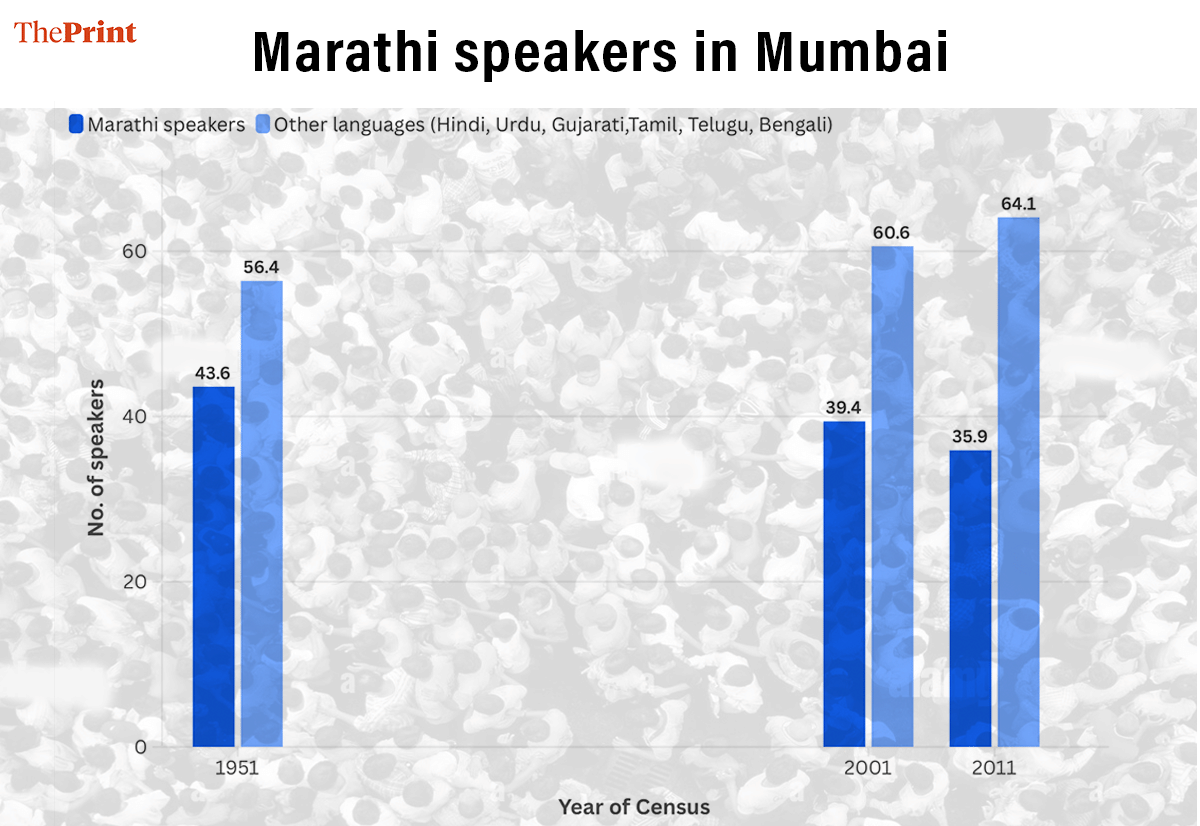
Historic knowledge illustrates that the dominance of Marathis has declined over time. The 2011 Census confirmed that Marathis remained the biggest linguistic group at 35.9 per cent. Hindi audio system accounted for 22.9 %, Urdu audio system 13.5 %, and Gujarati audio system 11 %, with many different languages spoken in smaller numbers. The 2001 Census had proven Marathi audio system making up about 39 % of town’s inhabitants, with Hindi, Urdu, and Gujarati audio system accounting for 16 %, 15 %, and 11 %, respectively.
Within the early post-Independence interval, a report by the Union authorities–appointed States Reorganisation Fee, primarily based on the 1951 Census, had famous that Maharashtrians constituted 43.6 % of Bombay’s inhabitants. Though they remained the biggest group, their share has fallen considerably over subsequent many years.
Additionally Learn: Thackeray cousins reunite: The clan that formed Maharashtra politics—from Prabodhankar to Aaditya
From Independence to liberalisation
The town was shaped 365 years in the past. It was all the time a cosmopolitan metropolis by nature.For the primary 200 years, it was a merchants’ city, additionally known as Manchester of the East.
Many merchants from completely different elements of India and past got here and settled within the metropolis: Hindu Gujaratis, Konkani Muslims, Jains, Parsis, Muslim-Khojas, Bohras, Memons, and so forth.
“For the primary 150 years, this was a Marathi minority city. However then, the industrialisation 150 years in the past modified it,” mentioned Mumbai-based metropolis chronicler Bharat Gothoskar.
The mushrooming of textile mills was the primary phenomenon to vary town. One factor that nonetheless has remained fixed is migration.
By Twenties—the height of textile manufacturing within the metropolis—25 % of town inhabitants was Ratnagiri born.
“Which suggests half was Konkani/Marathi talking and half was not. There was no idea of a linguistic state. Apart from that, six different languages had been spoken right here,” Gothoskar mentioned.
And when the division of Bombay state was to happen on linguistic traces, a category divide was happening in individuals’s minds as Marathis largely had been blue collar communities.
“On the time of Samyukta Maharashtra, it was an emotional concern the place individuals throughout get together traces participated, however on the similar time, it was additionally about class construction,” mentioned Dr Ajinkya Gaikwad, a professor of politics in Mumbai.
In the course of the Forties-50s, Mumbai grew to become a protest web site. From Give up India motion to Samyukta Maharashtra to labour union protests within the textile mills, town was bustling with individuals popping out on roads and combating for his or her rights.
After town obtained built-in with Maharashtra, 50 % of town was Marathi talking. The difficulty of ‘sons of soil’ cropped up as employment for ‘Marathi manoos’ grew to become a degree of focus. Shiv Sena was thus born in 1966 on the again of a motion led by a younger cartoonist, Bal Thackeray.
Within the preliminary days, Sena, which was extra of a social organisation than a political get together, was in direct battle with the Communists. However slowly within the 70s, the impact of Communists began fading, and Shiv Sena emerged because the political get together to reckon with within the Nineteen Eighties.
Throughout this era, the union strikes on the textile mills had been a typical sight.Although the mills had been owned by non-Marathis, the employees within the mills had been decrease center class Marathi individuals.
“The decrease center class and blue collar staff had been pitted in opposition to industrialists who had been non-Marathis/outsiders,” mentioned Gaikwad. “So, protests and strikes that befell that point had been cultural and sophistication oriented, and it was a lethal mixture because it put the economic system to a standstill as Mumbai was closely manufacturing oriented,” he added.
With the mills closing within the 80s, ‘Marathi manoos’ who stayed within the chawls of central Mumbai grew to become jobless. The areas left vacant by the mills had been transformed into malls, and a enterprise district began flourishing within the space.
The ‘Marathi manoos’ left and settled outdoors town limits as their households expanded.
Because the economic system began to open up, Mumbai’s id modified from industrial hub to monetary hub.
“As manufacturing diversified into smaller items, the variety of staff dropped. And therefore their energy to protest dwindled. Socialists and communists had unions in massive factories however that modified over time and it grew to become simple to manage staff’ unions,” mentioned Gaikwad.
Neo-liberal interval
From the 90s, town opened as much as varied financial alternatives and folks’s stream into town began growing quickly.
Because the job construction modified, the kind of migration additionally modified, mentioned Dr Uttara Sahasrabuddhe, former Mumbai College professor.
“Individuals who used to come back to Mumbai for industrial jobs had been much less educated. Later, these coming into town had been professionally educated. And so the kind of individuals modified, they usually introduced a political tradition completely different from that of the decrease center and higher center courses. This befell due to demographic change,” she mentioned.
The town’s Marathi talking inhabitants began dipping and Hindi talking inhabitants began ascending, impacting Shiv Sena.
This additionally included the Muslims coming from the Hindi belt whereas the Konkani Muslims’ numbers dropped.
Slowly, Hindi began taking centrestage.
This was the appearance of the neoliberal economic system the place the state equipment withdraws and lets non-public company takeover.
“This idea revolves round revenue somewhat than welfare and finally the ethics of town adjustments,” mentioned Dr Ajinkya Gaikwad. “It permits us to monetise and privatise all the things, due to which, the character of town adjustments.”
The bigger implication was that folks stopped caring in regards to the society and metropolis, and analysts say that town was okay with not having corporators for a few years.
Gaikwad identified it may very well be one of many the explanation why individuals stopped being vocal within the metropolis. For example the purpose, he gave the instance of the air air pollution protest and rising environmental activism.
“The activism is in spurts however is the bigger part of town speaking about it? Who’s speaking actually about it?” requested Gaikwad.
That is additionally manifested within the poor voter turnout within the metropolis.
Within the 2017 BMC elections, round 55.5 % of Mumbai’s voters solid their ballots. Within the 2019 Lok Sabha elections, turnout within the metropolis was about 52.4 %, down from roughly 55.4 % within the earlier common election. The 2019 Maharashtra Meeting polls noticed Mumbai voter participation at simply over 50 %. Within the 2024 Lok Sabha elections, turnout within the metropolis remained round 52.4 per cent, and knowledge from the 2024 meeting elections point out the same sample of participation, with turnout figures within the low- to mid-50s.
Mumbai South constituency, which has the prosperous and elite inhabitants, largely logs the poorest voter turnouts. As an illustration, within the 2024 Lok Sabha ballot, it noticed round 50 % voter turnout, with Colaba registering a dismal 43-44 %. This constituency homes businessmen, politicians, artists, largely Gujaratis, Marwadis, and Jains. The suburbs—Borivali, Mulund, Vile Parle, Byculla, and Mahim—registered higher turnouts in 2024, within the mid‑50s to low‑60s % vary, reflecting stronger engagement. These areas have a mixture of Marathis, Gujaratis, and Muslims.
Rise and fall of Shiv Sena and BJP
Shiv Sena, which began rising in prominence among the many Marathi talking inhabitants by way of varied authorities employment alternatives by means of the Lokadhikar Samiti, began altering its priorities within the Nineteen Eighties.
Since coming to energy for the primary time within the metropolis, the Shiv Sena had began making it extra Marathi. “It’s to the credit score or discredit of Bal Thackeray that he ensured that two thirds of elected representatives had been Marathi talking, they usually ensured Marathi audio system grew to become the mayor of Mumbai,” mentioned Gothoskar.
However the metropolis was altering, Bal Thackeray realised that he couldn’t maintain the get together on the difficulty of ‘Marathi Manoos’ within the face of adjusting demographics. So, the get together began catering to the Hindutva ideology, giving an area for BJP to develop together with it. The get together had launched Marathi every day Saamna in 1988, and Bal Thackeray, in 1993, launched Dopahar ka Saamna to take the get together’s ideology and ideas to North Indian voters.
In 1997, when Shiv Sena got here to energy with BJP in BMC, it began a streak that performed out until 2017. By 2017, when each the Sena and BJP fought individually, the latter was already a giant brother within the state and will win seats at par with the Sena in BMC—a warning signal.
In the meantime, what was began by Bal Thackery has continued. Of late, Shiv Sena below Uddhav Thackeray did an outreach programme for Gujaratis in 2022 and likewise carried out a Raas Garba operate. They despatched Priyanka Chaturvedi, a Hindi speaker, to Rajya Sabha.
Again and again, members of Uddhav Thackeray’s Sena have mentioned that they’re in opposition to the violence meted out in opposition to North Indians. Raj Thackeray additionally did an outreach programme for the Gujaratis forward of the 2019 Lok Sabha elections.
The main focus of governance additionally modified over time, and when BJP began specializing in growing infrastructure in Mumbai to cater the Gujarati talking and Hindi talking populations amid their rising inhabitants, different events adopted go well with.
What the Congress had tried to do on the state degree with planning metros and Navi Mumbai airport, however stopped brief. Giving powers to MMRDA (Mumbai Metropolitan Area Improvement Authority) and increasing Mumbai limits to reflect Delhi NCR had been plans from Congress-NCP occasions, however acquired a a lot wanted push when Devendra Fadnavis grew to become the CM.
Since many individuals residing on the outskirts of Mumbai had been coming to Mumbai for work, the enlargement of metros, roads, tunnel networks was a giant enhance of their on a regular basis journey, which BJP understood, mentioned Sahasrabuddhe.
“This infrastructure push is catering to a brand new center class that has migrated and residing right here for a very long time and their long run calls for are being catered to they usually see this as BJP doing it and therefore BJP’s assist is rising,” she mentioned.
Gothoskar mentioned that the Hindi talking and Muslim populations are persevering with to rise and the Marathis and Gujaratis are receding.
“So for the primary time, someone will problem Marathi talking individuals when it comes to the impression and that’s going to be understood primarily based on whether or not there will probably be a Marathi talking mayor or not. That’s one thing distinctive,” he mentioned.
(Edited by Madhurita Goswami)
Additionally Learn: Inner combating noticed Mahayuti & MVA type unlikely ties in some seats. How they fared in Maharashtra
Source link
latest video

latest pick



news via inbox
Nulla turp dis cursus. Integer liberos euismod pretium faucibua



