


From Modi-baiter to BJP’s bridge in Bihar
Having secured a document tenth time period in workplace barely three months in the past, Nitish, extensively credited for pulling Bihar out of a governance morass within the early years of this millennium, and panned for his political prevarications over the previous decade, is now set to relinquish the chief minister’s chair in a surprising political denouement.
In some ways, Kumar’s repeated makes an attempt to the touch Modi’s toes had been a prelude to the political developments which have now unfolded in Patna, marking the fruits of a protracted and inconceivable journey from visceral dislike to open genuflection.
In spite of everything, Kumar as soon as discovered Modi so politically repugnant that he pulled the plug on his 17-year alliance with the BJP in 2013. “We can’t have a person who’s a divisive determine… There can’t be any compromise with this particular person, who’s a risk to our concord,” Kumar was quoted as saying after the BJP named Modi the chief of its 2014 Lok Sabha election marketing campaign, successfully anointing him because the celebration’s prime ministerial candidate.
With the centre of gravity of Indian politics but to take a decisive rightward flip on the time, the antipathy Nitish harboured in direction of Modi was not tough to elucidate. All of the extra so for a person steeped within the beliefs of socialist icon Ram Manohar Lohia and politically baptised in the course of the Sampoorna Kranti Motion towards the Indira Gandhi-led Congress, spearheaded by Jayaprakash Narayan.
Born in 1951 in Bakhtiyarpur close to Patna, Nitish, a person of reticent disposition, moved to the state capital in 1966 to review at Patna Science Faculty. He would later go on to earn a level in Electrical Engineering from the Bihar Faculty of Engineering in 1973.
राज्य सभा के लिए अपना नामांकन पत्र दाखिल किया। pic.twitter.com/R9mDOHUfYr
— Nitish Kumar (@NitishKumar) March 5, 2026
Nitish’s first brush with politics got here throughout his Patna Science Faculty days, when he joined the Samajwadi Yuvjan Sabha, the youth wing of Ram Manohar Lohia’s Samyukt Socialist Occasion. He later went on to function president of the Bihar Abhiyantran Mahavidyalay College students’ Union (BAMSU).
His early years in Patna coincided with the regular rise of Lalu Prasad Yadav within the state’s political firmament as a pupil chief. But the distinction between the 2 may hardly have been starker – Nitish, who wore civility and decency on his sleeve, and Lalu, whose enchantment rested on an unabashedly rustic attraction.
Nitish even campaigned for Lalu who bagged the coveted submit of the president of the Patna College College students’ Union. On the similar time, he deepened his affiliation with the JP motion, having turn into a member of the Chhatra Sangharsh Samiti that was spearheading the protests and demonstrations that roiled Bihar on the time.
Additionally Learn: Modi-Nitish then & now — Two pictures, taken 13 yrs aside, replicate ‘cycle that’s moved full circle’
Solely fixed in Bihar
Through the Emergency, he was arrested and jailed beneath the Upkeep of Inner Safety Act (MISA).
Regardless of his early activism, Nitish’s electoral journey started with setbacks. He misplaced two successive Meeting elections from the Harnaut constituency – in 1977 as a Janata Occasion candidate, and once more in 1980 representing its splinter faction, the Lok Dal.
Nitish’s faltering political ambitions left him bitter and dejected, straining his relationship along with his spouse, Manju, whom he had married in 1973. At one level, he’s stated to have instructed her that he would stop politics if he didn’t get elected in his third try. Manju, who contributed Rs 22,000 to his marketing campaign fund, stood by him.
Within the 1985 Meeting elections, Nitish, bolstered by the backing of Janata stalwarts Chandra Shekhar and Devi Lal, mounted an organised marketing campaign and gained the Harnaut seat as a Lok Dal candidate by a margin of over 22,000 votes.
4 years later, in 1989, he was elected to Lok Sabha as a Janata Dal candidate, and returned once more in 1991, because the nation entered a interval of political churn marked by the decline of the Congress and the rise of regional events, lots of them offshoots of the Janata Parivar that had nurtured leaders equivalent to Nitish and Lalu.
In 1990, whereas serving as a minister of state within the V.P. Singh authorities on the Centre, Nitish performed a key function in Lalu’s elevation as chief minister of Bihar. For the subsequent decade and a half, that call would show to be his greatest undoing, as Lalu steadily consolidated his grip over the state’s politics, driving the wave of Mandal politics and pushing contemporaries like Nitish to the margins.
“By 1992, Nitish was not on speaking phrases with Laloo Yadav,” wrote the late Sankarshan Thakur in The Brothers Bihari, his acclaimed biography of the 2 leaders whose rise and fall, friendship and rivalry got here to form Bihar’s politics over almost 4 many years— a journey on which Nitish successfully drew the curtains on Thursday.
“Once we labored to elect you, we had believed you’ll undo the corruption and misgovernance beneath the Congress rule. However none of that has occurred, and also you appear bored with something apart from perpetuating your self in energy and pandering to your coterie,” Nitish wrote in a missive to Lalu, as documented within the ebook Bihar: The Politics of Letters by journalist Srikant.
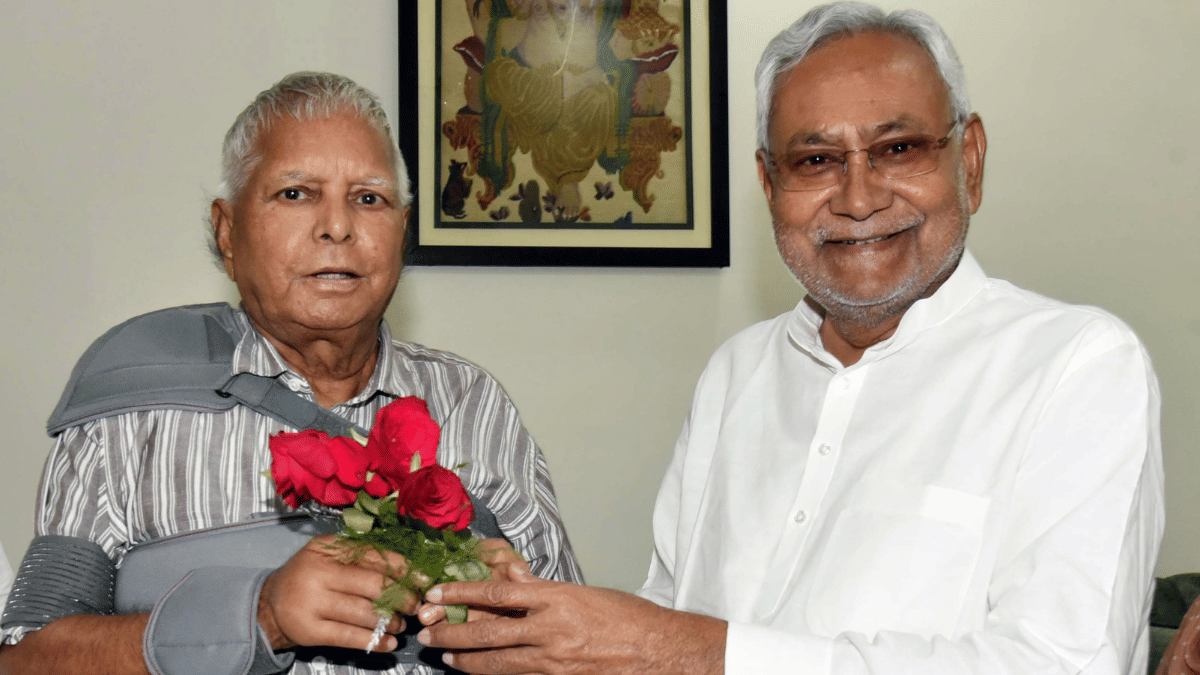
In 1994, Nitish parted methods with Lalu, teaming up with George Fernandes to type the Samata Occasion. A lot of that formation would later merge into the Janata Dal (United) in 2003, which Nitish continues to helm. He allied first with the United Entrance and later with the BJP, registering success within the Lok Sabha elections of 1996, 1998 and 1999.
But, at the same time as Nitish tasted success in nationwide politics by way of the Nineties, energy in Bihar remained elusive. Lalu, regardless of struggling setbacks, together with a jail time period within the fodder rip-off that pressured him handy over the chief minister’s submit to his spouse Rabri Devi, held firmly on to his formidable Yadav-Muslim assist base.
Within the 2000 Meeting elections, the JD(U)-BJP mix ended up with two extra seats than the ruling RJD. The NDA authorities on the Centre, by way of the Governor, acquired Nitish sworn in as chief minister for the primary time on 3 March 2000.
The federal government lasted barely every week, collapsing after it didn’t muster the numbers required to show its majority on the ground of the Meeting. The identical yr noticed the carving out of Jharkhand from Bihar. It was a transfer that Lalu would by no means have accredited had he not been beholden to Congress’s assist.
Thakur wrote in his ebook that Nitish turned the unintended political beneficiary of that call. The undivided Bihar had a 324-member meeting and despatched 54 MPs to the Lok Sabha. Publish-division, the meeting was diminished to 243 and the variety of Lok Sabha seats to 40.
“Within the previous association, the BJP was Nitish’s senior Bihar ally because it claimed almost all of the Jharkhand space seats. The brand new, smaller Bihar meant that Nitish turned the bigger shareholder within the alliance: 25 of the 40 Lok Sabha seats and 139 of the 243 within the meeting. Slowly he started to dictate the Bihar alliance. He acquired his choose of seats, he laid down the bottom guidelines, chief of which was that within the Bihar scheme he would set agenda and beliefs,” noticed Thakur.
The yr 2005 lastly marked Nitish’s arrival as a central determine in Bihar’s politics, the fixed survivor within the state’s political minefield till Thursday. After the primary spherical of Meeting elections threw up a fractured mandate, albeit one which significantly weakened the RJD, the second election later that yr introduced Lalu to his knees, paving the way in which for Nitish’s first full five-year time period in workplace.
Nitish set in movement a metamorphosis in Bihar’s governance, significantly in infrastructure and regulation and order, throughout his first full tenure as chief minister, whereas additionally assiduously constructing a loyal voter bloc among the many Economically Backward Lessons (EBCs), drawing assist from non-dominant OBCs, Muslims and higher castes.
“पूरी तरह से भाजपा ने नीतीश कुमार को हाईजैक कर लिया था, आज यह बात साबित हो गया है!”@yadavtejashwi#RJD #TejashwiYadav #bihar pic.twitter.com/M6YRRbzOqN
— Rashtriya Janata Dal (@RJDforIndia) March 5, 2026
5 years later, he was rewarded on the hustings, successful 115 seats, the highest-ever tally notched up by the JD(U) up to now. The sky appeared there for the taking for Nitish, who was more and more being seen in political circles as a future prime ministerial contender.
It was round this time that Modi started making his presence felt within the nationwide political discourse. For years, Nitish prevented even taking Modi’s identify in public and ensured that the BJP stored Modi away from political programmes in Bihar.
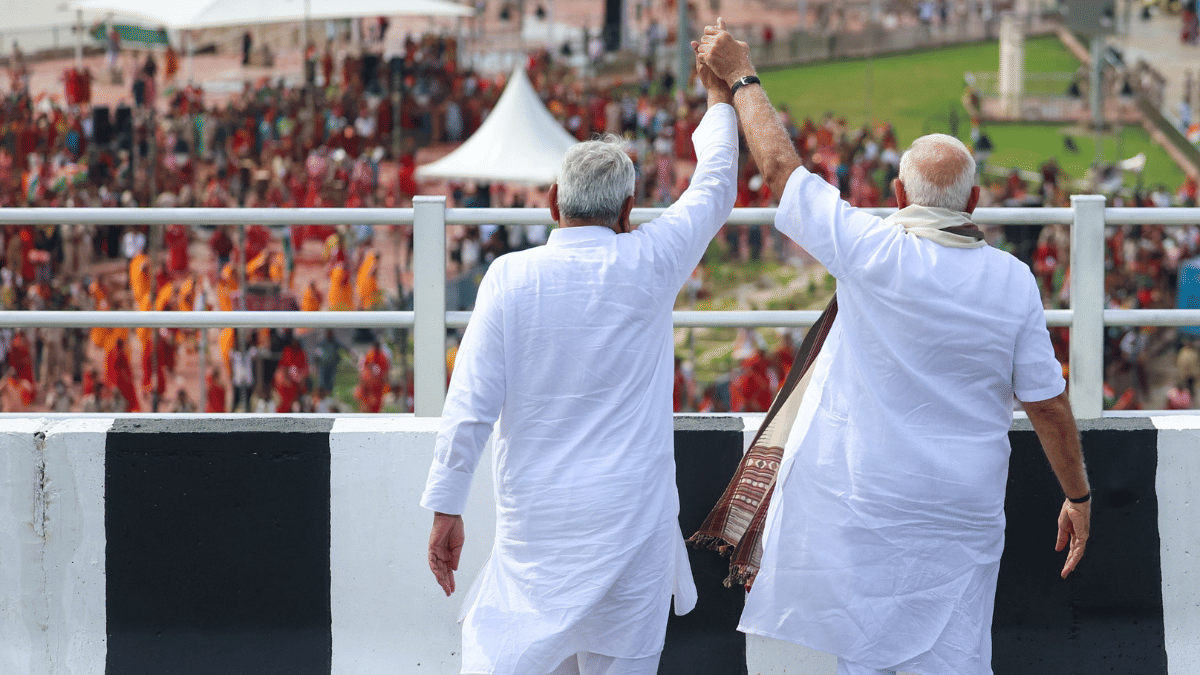
Forward of the 2009 basic elections, a reluctant Nitish joined an NDA rally in Ludhiana after being persuaded by the alliance’s prime ministerial candidate L.Okay. Advani and BJP chief Arun Jaitley. On the stage, Modi clasped Nitish’s hand and held it aloft earlier than a cheering crowd – an act that reportedly left the Bihar chief minister fuming.
In 2010, he even returned Rs 5 crore in aid funds donated by the Modi-led Gujarat authorities for the 2008 Kosi flood victims. And as beforehand talked about, he snapped the JDU’s ties with the BJP in 2013 after it turned evident that Modi could be projected because the celebration’s prime ministerial candidate.
The flip-flops
The BJP’s sweeping victory within the 2014 basic elections, which additionally decimated the JD(U) in Bihar, rattled Nitish. Taking ethical duty for the defeat, he stepped down as chief minister and put in Jitan Ram Manjhi in his place. Months later, he returned to the submit, patched up with Lalu Prasad Yadav in a unprecedented show of political expediency, and handed the BJP a crushing defeat within the 2015 Meeting polls.
Inside two years, nevertheless, he returned to the NDA fold, as soon as once more tying up with the BJP and ditching the RJD. Within the 2020 Meeting elections, the JD(U) took a battering, however Nitish retained the chief minister’s submit in coalition with the BJP. In 2022, he switched sides but once more, becoming a member of arms with the RJD, Congress and the Left to type a brand new authorities, remaining on the helm.
By 2024, because the nation headed into one other spherical of Lok Sabha elections, Nitish jumped ship as soon as extra, abandoning the INDIA bloc after it failed to call him as its convener regardless of his need to steer it. “I’m not going wherever hereon,” Nitish, by then extensively dubbed ‘Paltu Ram’ for his frequent political somersaults, remarked when requested about his strikes.
In November 2025, Nitish returned to energy with a cushty mandate, along with his celebration, the JDU, successful 85 seats and the BJP-led NDA securing a landslide 202 of the 243 seats within the Bihar Meeting.
At the same time as he held on to the reins of energy, the thrill round Nitish’s evidently failing well being and reminiscence grew louder, fuelled by a string of surprising public episodes – putting a flower pot on the pinnacle of an officer at a authorities operate, making graphic remarks whereas explaining contraception within the Meeting, gesturing and talking whereas the nationwide anthem was being performed, flattening the hijab of a Muslim medical pupil throughout an interplay, and certainly, makes an attempt to the touch Modi’s toes.
For a person who as soon as vowed, in a second of frustration after an early electoral defeat, that he would achieve energy “somehow” after which do good work with it, Nitish’s political journey finally turned a narrative much less about governance than about political survival.
(Edited by Ajeet Tiwari)
Additionally Learn: Nitish’s exit is sweet for Bihar. It’s the start of JD(U)’s finish and BJP’s supremacy
latest video

latest pick






news via inbox
Nulla turp dis cursus. Integer liberos euismod pretium faucibua



