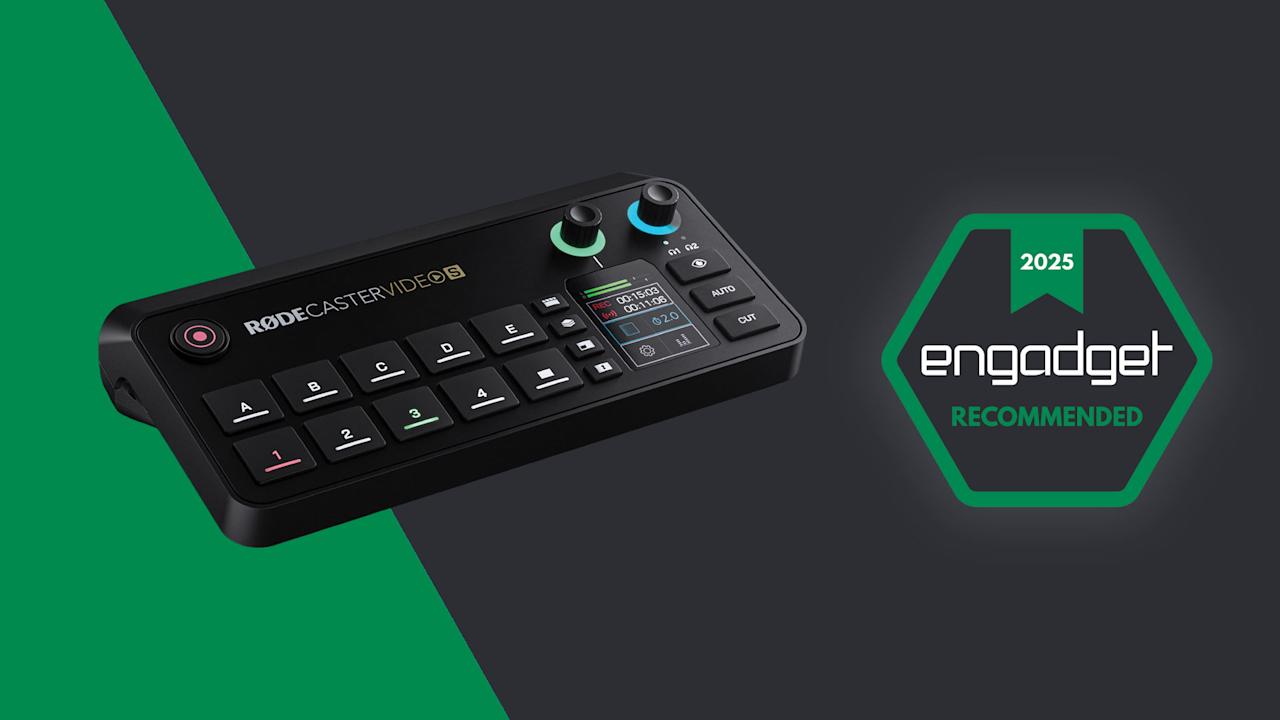
Compact and complete video manufacturing
The Rodecaster sequence of podcast mixers have grow to be a mainstay amongst audio creatives. Final 12 months, the corporate expanded the road with its first multimedia mannequin — the Rodecaster Video. It was a extra area of interest proposition, geared toward streamers, video podcasters and stay producers, and, at $1,200, individuals with deeper pockets. Right now, Rode returns with the Rodecaster Video S (RCV-S), a streamlined model that gives a lot of the identical performance for lower than half the price of the unique ($499).
In the event you presently use Ecamm Stay, OBS, a Stream Deck, a Rodecaster Pro/Duo, a video capture card or Blackmagic Atem kind switcher, then there’s a superb probability the RCV-S does one thing, or many issues, helpful to you. Perhaps it could change all these merchandise, a few of them or improve your workflow. It’s somewhat sophisticated, however inside that complication is quite a lot of versatility.
Rode’s second video-focused Rodecaster presents complete manufacturing instruments that just about rival the older, dearer unique Rodecaster Video in a smaller package deal. The dearth of 4K will frustrate some, however the versatility and have set will make it a compelling package deal for creators of all kinds.
- Respectable connectivity
- Standalone manufacturing capabilities
- Wi-fi digicam appropriate
- Onboard storage for media
- No 4K
- Bodily audio controls are missing
With three HDMI inputs, one USB webcam/mic enter and as much as 4 NDI/wi-fi digicam inputs, video is clearly the main target right here. However there are additionally two XLR/Combo ports for studio microphones and devices and the choice to attach as much as two of Rode’s wi-fi lav mics (such because the Wireless Go) instantly with out the necessity for a receiver. The RCV-S, like Blackmagic’s fashionable Atem Mini, outputs over HDMI at 1080p/60 (no 4K) or can be utilized over USB as a digital digicam identical to you’d discover in Zoom or Groups.
Not like the Rodecaster Professional or Duo, there aren’t any faders; as a substitute, there are two rows of pads for switching between video sources and scenes. There’s 20GB of onboard storage for media — similar to overlays, graphics and audio/video clips — and you’ll file reveals instantly onto USB hard-drives or stream natively to Twitch, YouTube and different platforms through RTMP/S. There’s so much happening, and the way you wish to use all of it is essentially as much as you. Whereas the RCV-S leans extra towards “stay” productions similar to streaming or podcasts, you need to use it for typical YouTube-style video manufacturing, relying in your workflow or video preferences.
Rodecaster Video versus Rodecaster Video S
The large value distinction between the unique Rodecaster Video and the brand new S mannequin would possibly lead you to anticipate some critical characteristic trimming this time round, however Rode’s backyard shears have been pretty form. Most notably, the variety of sources you may join has been diminished from six to 4. In the meantime, the variety of “scenes” you may create is now 5, down from seven. As talked about above, there are three HDMI inputs, not 4, and just one USB webcam/mic enter, down from two on the unique. There are nonetheless 9 channels of audio with two headphone outputs, however the line outputs on the unique are now not right here. The SD card slot for media has additionally been eliminated in favor of inner storage. In brief, there’s somewhat bit much less connectivity, however not sufficient for it to really feel hobbled, particularly for the extra informal customers that is clearly geared toward.
In-use
At its most elementary, the RCV-S is an all-in-one video switcher. You don’t want to attach it to a PC, simply plug in your video and audio sources and you’ll bounce between them in actual time with a alternative of transitions. For a extra polished manufacturing you may create “scenes” through the menu with a choice of layouts for a number of cameras, picture-in-picture and so forth. That might be two speaking heads for a podcast, overlaying your internet digicam on prime of your gameplay or a top-down digicam blended with a distinct perspective for cooking tutorials or displays.
You may create scenes instantly on the system prematurely or stay through templates, however issues get so much simpler and extra artistic while you use Rode’s companion Rodecaster app. Right here, you’ll discover a “scene creator” device that’s each visible and intuitive, plus it has the choice to make customized layouts the place you may freely resize and place all of your totally different media wherever you need, add borders or rounded corners and so forth.
Whereas the principle pads are primarily for switching between sources and scenes, they will additionally set off media — pre-made video clips, overlays and graphics, for instance. You may assign media to them with out decreasing the variety of sources/scenes which are accessible to change between, simply faucet the Media/Overlay button to quickly change the performance of the pads. You may as well arrange chromakey/inexperienced screening instantly on the system or through the Rodecaster App, too.
Upon getting the whole lot arrange, you may instantly file output onto a USB SSD, once more, with out the necessity for a PC. There’s even the choice to file solely the principle output (“program”) or a multi-track model which is able to export a recording of each enter as a separate file which you can edit as you see match. That is useful when you’re utilizing apps like Adobe Premier or Davinci Resolve. In the event you shoot multi-camera dance tutorials, for instance, you may bounce between your major and extensive digicam after which to a detailed up with out having to hunt-down the appropriate half from every file you recorded on totally different reminiscence playing cards.
Rode not too long ago up to date the Rodecaster Video firmware so as to add help for as much as 4 “NDI” wi-fi cameras as further sources. Usually these are distant or security-style cameras, however Rode’s Seize cell app additionally helps NDI streaming, that means you need to use your cellphone wirelessly as one other digicam which you can change to, which is especially helpful. Although do observe, the Rodecaster Video will must be hard-wired to your router on the identical community as your cellphone for this to work.
Audio

The Rodecaster Video S handles audio and video with ease. (James Trew for Engadget)
Whereas the RCV-S presents 9 audio tracks, it’s honest to say it isn’t actually designed for stay audio mixing within the pure sense since there aren’t any faders. As an alternative, it’s a must to entry totally different channels through the menu on a small show and a dial — It’s quite a lot of looking and pecking. In the event you’re related to a PC, the Rodecaster app does provide a software program mixer with faders although, which makes adjusting ranges on the fly a lot simpler.
The excellent news is that some voice enhancement instruments, similar to Depth, Sparkle and Punch have been carried over from the Rodecaster Professional/Duo, providing you with somewhat extra fine-grained management over the way you or your visitors sound.
There’s a slight disadvantage when utilizing the RCV-S as a standalone unit, in that you could bodily push the buttons to vary the scene, which could not be very best when you’re attempting to make a sophisticated recording or can’t at all times be close to the console. Fortunately, Rode has an answer in “auto switching.” I’m mentioning it right here, within the audio part, because the RCV-S can change cameras based mostly on which one has the strongest audio or based mostly on user-defined precedence. Usually, that will be whoever is speaking in a podcast, nevertheless it is also in-game sound or while you change to enjoying a musical instrument.
Auto switching works effectively, nevertheless it’s not fairly reliable sufficient to depend on for full autonomy in knowledgeable atmosphere — say whereas recording a panel at a convention — nevertheless it solves an issue when you’re by yourself, and it may at the very least save a while in an informal podcast state of affairs.
Issues to think about

The Rodecaster Video S (prime) vs. The Rodecaster Video (backside) (James Trew for Engadget)
It’s clear that the RCV-S, regardless of having fewer inputs than the unique Rodecaster Video, continues to be fairly a posh, open-ended device. If you have already got a streaming setup you want and the software program and interfaces you want, then the enchantment of the RCV-S might be down as to if it could do what you want extra effectively. For stay video manufacturing, it’s a better promote, as there aren’t many all-in-one gadgets to compete with it that can be utilized standalone.
For instance, Blackmagic’s Atem sequence is extremely fashionable, and till now, had the benefit on value with the Mini Professional costing simply $330. Even the Mini Professional ISO ($550) that exports multi-track video was half the value of the unique Rodecaster Video. The RCV-S now presents comparable connectivity, onboard recording, extra expansive audio options and multi-track export for $50 much less.
For normal content material creators it’s somewhat trickier. As somebody that makes YouTube movies, the enchantment to me is the prospect to consolidate just a few gadgets into one and take away some friction in my recordings. Proper now, I’ve a Rodecaster Duo dealing with my audio, a seize card for my major digicam and I swap out that digicam for a smaller one if I’m taking pictures top-down footage or want a second angle. Which means I’ve a number of totally different gadgets on my desk, and I’m consistently doing a dance of unplugging issues and juggling media or totally different recordings earlier than I get the whole lot able to edit.

The Rodecaster Video S has a tiny show for menus and settings. (James Trew for Engadget)
With the RCV-S I can ditch my standalone seize card and completely depart a number of cameras related to the Rodecaster in order that they’re able to go at any time. I may even take away the Rodecaster Duo and convey it again out once more on the events I want extra quick management over a number of sources of audio (which is usually, however not usually). The enchantment in my case is fewer gadgets on my desk, and the power to file multi-camera video with out having to arrange each shot, each single time, which saves vital time that I can then use to really get extra work performed.
There are, after all, some limitations. Not least of all is the shortage of 4K. I’m nonetheless inclined to file on digicam for my major shot to make sure I nonetheless have a 4K copy for YouTube after which use the Rodecaster Video S for the whole lot else, however as a small creator, comfort and suppleness could be very interesting. For streamers and stay video manufacturing, the Rodecaster Video S is a really succesful device that gives a variety of performance for an accessible value that can little question grow to be the central hub for a lot of creators.
The true kicker right here is the value. Let’s be clear, $500 continues to be vital cash. However at lower than half the value of the unique Rodecaster with respectable connectivity and mainly the identical performance, it is a straightforward advice to those that had been holding off based mostly on value alone. Likewise, when you’re simply beginning out with content material creation and wish one thing with strong video credentials and audio chops, Rode makes a superb case for itself with the Rodecaster Video S.
Source link
latest video

latest pick



news via inbox
Nulla turp dis cursus. Integer liberos euismod pretium faucibua