


Basant Panchami in Braj – Celebrating the King of Seasons
सदा बसंत रहत वृंदावन पुलिन पवित्र सुभग यमुना तट।
जटित क्रीट मकराकृत कुंडल मुखारविंद भँवर मानौं लट।।
Though Braj is a spot of many seasons and festivals, there’s one season that’s all the time current in Braj with all its festivity. That’s the Spring season or Vasant Ritu – the king among the many seasons. Acharya Rasik Ji of Vrindavan even stated that the spring season by no means leaves Braj even for a second. Quite the opposite, it’s all the time current in Braj, in service of Shree Radha Krishna. Basant Panchami is widely known in Braj within the Spring season to commemorate Braj individuals’s love in direction of Shree Radha Krishna.

In accordance with astrology and Ayurveda, Vasant Ritu comes within the Chaitra and Vaishakh months of the Hindu calendar. Sushrut, inventor of Shalya Chikitsa or surgical procedure stated about Vasant Ritu, “मधुमाधवौ वसन्तः”, which suggests Madhu(Chaitra) and Madhav(Vaishakh) are Vasant. Taittariya Samhita says “मधुश्व माधवश्व वासन्तिकावृत”, which suggests Madhu and Madhav collectively are Vasant Ritu. Taittariya Brahman explains seasons as “तस्य ते वसन्तः शिरः”, which suggests head of a 12 months is Vasant Ritu. Kalidas explains Vasant Ritu so superbly in his well-known Sanskrit mini-epic, Ritusamhara as “सर्वप्रिये चारूतरं वसन्ते”, which suggests all the things appears so stunning in Vasant Ritu or Spring season. Well-known poetry Geet Govinda composed by poet Jaidev Gosvami says, “विहरति हरिरिह सरस वसंते”, all of the instructions are very glad after union with Vasant.
Nonetheless, in North-East India onset of Vasant Ritu or Spring season is taken into account to be on Vasant Panchami day which is on Panchami or the 5th day of Shukla Paksha within the Magha month of the Hindu calendar. Shukla Paksha is that fortnight of the lunar month wherein the moon goes from new moon to full moon.

Let’s discuss concerning the onset of the spring season. In Magha month, Surya Devata, Solar God, enters Makara Rashi after which the winter season goes on the decline. The arrival of Rituraj Vasant, the king of seasons, on Earth on this fifth day of Shukla Paksha of Magha month is widely known as a pageant. The great thing about mom Earth is at its peak when she welcomes the spring season. On the arrival of the spring season, the entire universe feels intoxicated. Recent new leaves on the timber, flowers laden branches, mango blossoms, stunning sound of cuckoo’s prepare dinner, yellow coloured fields of mustard as if mom earth has draped a yellow odhani, indicating loudly that spring has come.

Braj celebrates the spring season with nice delight and gaiety. On the one hand individuals of the nation have fun this pageant by dressing in yellow garments and worshipping Devi Sarasvati, goddess of mind, however, individuals of Braj have fun this pageant in a really distinctive approach. Vasant Panchami day kick begins the well-known 40-day lengthy Holi celebration, the pageant of colors in Braj. Vasant Panchami or Basant Panchami is taken into account the primary day of the Holi pageant in Braj. In Shrimad Bhagwat Geeta, lord Krishna describes himself as spring season.
बृहत्साम तथा साम्नांगायत्री छन्दसामहम।
मासानां मार्गशीर्षोहमृतूनां कुसमाकरः।।
Amongst scriptures in verse, I’m Brihatsama. Amongst Vaidic verses, I’m Gayatri Chhand. Among the many six seasons, I’m Vasant or Spring season.
Within the villages, cities and temples of Braj, the custom of celebrating the Vasant pageant is continuous ceaselessly until at present. The day of Vasant Panchami kick begins Vasant Utsav in Braj. On today, Thakurji or Lord Krishna is wearing yellow garments. All temples are adorned with yellow coloured decorations, garments and flowers. Even the monks costume in yellow-colored garments and enter the temples to serve the deity. On the event of the Vasant Panchami pageant, newly blossomed yellow flowers of mustard are supplied to Thakurji. Trying on the enchanting seems to be of their beloved Krishna, the individuals of Braj get enveloped in his love and affection and instinctively begin singing –
“श्यामा श्याम बसंती सलोनी सूरत को श्रंगार बसंती है”
The aura of Shri Radha Krishna can also be Vasanti, that’s ever recent. His adornment can also be Vasanti.
On the day of Vasant Panchami, a pole is erected for Holi which is named danda or khunta. Round this pole, the wooden logs are stacked vertically to carry out Holika Dahan. Holika Dahan is related to the annual bonfire on the evening earlier than Holi. The story of Holika Dahan (Holika’s dying) signifies the triumph of righteousness over evil. The day of Vasant Panchami marks the start of celebrations of Holi which takes place forty days later.
Until Holikashtaka or until 8 days previous to Holi, throughout rajbhog within the afternoon, individuals play with colours. It’s known as Abir-Gulal. On the planet-famous temple of Thakur Banke Bihari, one other identify for Lord Krishna, colours are thrown on devotees as Prasad.

Within the Shah Bihari temple of Vrindavan, the Basanti chamber is open for 3 days from Vasant Panchami. This Basanti chamber is lit with multicolored lighting which heighten the ethereal aura of Thakur Radha Raman Lal, one other identify of Krishna, seated gracefully within the room. This room is open for these only a few days a 12 months. Chandeliers, imported from Belgium, gracefully improve the great thing about the chamber. Folks make bamboo umbrellas and beautify them superbly.
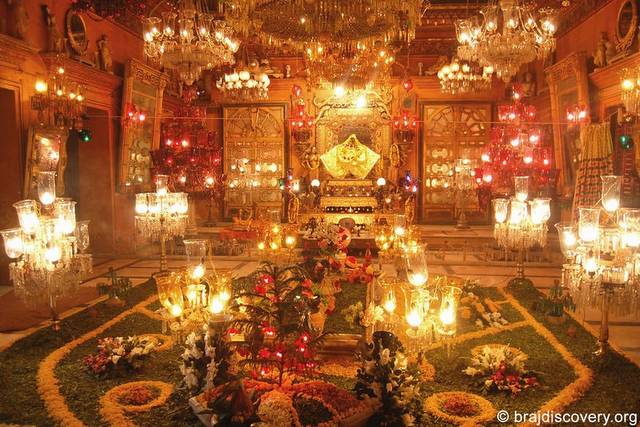
They take out the procession holding their umbrellas and singing Fag songs. Within the evening they sing Chaita songs. With this procession, Basant Utsav or pageant begins in main temples of Vrindavan like Shri Radha Vallabh temple, Shri Radha Raman temple, Shri Raj Bihari Kunj Bihari temple, Shri Radha Damodar temple and different temples of Vrindavan.
कुहू कुहू कोकिला सुनाई। सुनि सुनि नारि परम हरषाई।।
बार बार सो हरिहि सुनावति। ऋतु बसंत आयौ समुझावति।।
फाग-चरित-रस साध हमारै। खेलहिं सब मिलि संग तुम्हारै।।
सुनि सुनि ‘सूर’ स्याम मुसुकाने। ऋतु बसंत आयौ हरषाने।।
Listening to the cuckoo’s candy prepare dinner, all the feminine mates or Sakhi of Krishna are very glad and they’re coaxing Krishna to come back with them and play, saying, O beloved, the spring has arrived. Please include us for the celebrations. Ultimately, Krishna yields to their requests with a fascinating smile on his face and goes alongside together with his Sakhis to have fun Vasant Utsav.

Within the temples of Vrindavan, Samaaj carried out for Vasant Utsav may be very enchanting. Samaaj is a method of singing praises to the lord. In oral literature, one such music, ‘Shyama Shyama ke Basant Khel’ is described very elaborately. These songs are carried out in entrance of Thakurji together with conventional musical devices. This apply of singing Basant is a really outdated custom in Braj. Well-known singer and saint trio, Swami Shri Haridas Ji, Shri Hariram Vyas Ji and Shri Hit Harivansh Ji, known as Haritrai or the trio who reward the Lord, have created many verses praising Basant. In Vrindavan, until at present, even after about 500 years, these verses are sung as a temple custom. In Braj the custom of Basant worship therefore is actually historical.
Basant Panchami In Braj – Worship
In a scripture known as ‘Mahavani’, the Basant worship course of is defined fairly elaborately, which is carried out in Golok Vrindavan (Everlasting Vrindavan the place solely Radha Krishna and his Sakhis exist) by Krishna’s feminine mates. Primarily Mahavani elaborates superbly on how Krishna’s Sakhis supply flowers and songs to Krishna and worship him. It’s known as Vasant Seva of Shri Radha Krishna.
As Bhoum Vrindavan or Earthly Vrindavan is a picture of Golok Vrindavan, comparable celebrations are accomplished in Vrindavan and Braj on the event of Vasant Panchami. As per “Haribhakti Vilas’, Puja is carried out by providing new leaves, flowers and different puja supplies to Krishna in varied temples on Vasant Panchami. New-grown yellow flowers of mustard are supplied to Shri Radha Krishna. Shri Krishna can also be served within the type of music efficiency which is an inseparable a part of Seva custom in Vrindavan and crucial for Vasant Panchami celebrations. Vasant Rag begins from today. Samaj singing entails singing verses in Vasant Rag of classical singing model.
और राग सब बने बराती दुल्हो राग बसंत,
मदन महोत्सव आज सखी री विदा भयो हेमंत।
All different ragas are the wedding celebration, raga Basant is the bridegroom. It’s a joyous pageant time after bidding farewell to Hemant Ritu or the winter season.
Rasik Shiromani Swami Haridas is singing praises of this divine Ras pageant in Ras Nukunj of Vrindavan the place Kunjbihari is celebrating Vasantotsav. Kunjbihari is one other identify for Krishna.
कुंजबिहारी कौ बसन्त सखि, चलहु न देखन जाँहि।
नव-बन नव निकुंज नव पल्लव नव जुबतिन मिलि माँहि।
बंसी सरस मधुर धुनि सुनियत फूली अंग न माँहि।
सुनि हरिदास” प्रेम सों प्रेमहि छिरकत छैल छुवाँहि।।
Krishna’s Sakhi or a feminine good friend is asking all her mates to come back along with her to the backyard, full of recent leaves and engulfed within the divine feeling of Vasant, the place Krishna is enjoying a candy tune on his flute. Everybody current within the backyard is soaked in divine happiness. Colors being thrown on them is nothing however Krishna’s love showered on them.
‘मधु मुकुल’ or Madhu Mukul composed by Bharatendu Babu has these traces which describe Basant as,
एहि विधि खेल होत नित ही नित, वृन्दावन छवि छायो।
सदा बसन्त रहत जँह हाजिर,कुसुमित फलित सुहायो।।
On the divine recreation space, video games of Basant are being performed repeatedly. The season of Basant by no means leaves this place. Quite the opposite, it stays right here endlessly, repeatedly flowering and blossoming.
Vrindavan and Basant are inseparably related. You’ll be able to by no means discuss sufficient about it. The entire lifetime of Krishna is a illustration of novelty, an emblem of exuberance, the epitome of happiness. Which season might be higher than Vasant the place Krishna himself is exhilarated? The arrival of this season brings greenery throughout. Shedding the laziness of the winter season, nature as soon as once more begins blossoming as if shedding outdated garments, it’s able to cowl itself with vivid colourful new garments. The entire ambiance is full of peculiar power. Mustard fields are stuffed with yellow-colored flowers which fill the human coronary heart with heat.
Vasant in actuality is nothing however a hidden message given to your complete humanity by Shri Krishna, wherein he’s coaxing all of us to resurrect happiness in life, ignoring all of our illnesses and sufferings in order that pleasure and happiness keep throughout us endlessly as a result of so long as happiness is there, there’s the essence in life and so long as the essence is there, solely then there’s a novelty. There may be pleasure within the essence of life so long as it’s novel and recent. Because it will get stale, degeneration begins. Retrogress begins. At all times make your life as Vrindavan in order that novelty and freshness persist in life and Krishna himself stays in your coronary heart endlessly because the epitome of happiness or ‘Rasmurti’.
नवल वसंत, नवल वृंदावन, नवल ही फूले फूल,
नवल ही कान्हा, नवल सब गोपी, नृत्यत एक ही तूल।
नवल ही साख, जवाह, कुमकुमा, नवल ही वसन अमूल,
नवल ही छींट बनी केसर की, भेंटत मनमथ शूल।
नवल गुलाल उड़े रंग बांका, नवल पवन के झूल,
नवल ही बाजे बाजैं, “श्री भट” कालिंदी के कूल।
नव किशोर, नव नगरी, नव सब सोंज अरू साज,
नव वृंदावन, नव कुसुम, नव वसंत ऋतुराज ।
A brand new spring, new Vrindavan, new flowers have sprouted
Kanha seems to be new, as do Gopis as they dance collectively
Flowers are new, saffron is new and Kamdevs arrows are new
On the banks of Yamuna, new air flows making the colours unfold far & broad
New adolescents, new city, new devices
New Vrindavan, new flowers with a brand new Vasant season
It is a visitor publish by Sushant Bharti.
Sushant Bharti is a Conservation Architect. He graduated from the College of Planning & Structure, New Delhi with a Bachelor’s diploma in structure from Vastukala Academy Faculty of Structure. He has a eager curiosity in understanding the cultural side of India. Together with architectural variety, his fundamental space of analysis is across the ‘Cultural Heritage of Braj’ and “Indian Temple Structure”. At present, he’s working as a Analysis Assistant on the Nationwide Museum Institute, Nationwide Museum, Janpath, New Delhi.
Learn Sushant’s publish on –
RasikPriya – The Geet Govind of Bundelkhand
Sanjhi Art – Folk Art of Decoration at Braj Vrindavan
Phool Bangla Tradition of Braj: In The Light of Vrindavan
Translation – Madhumita Tamhane
Source link
latest video

latest pick






news via inbox
Nulla turp dis cursus. Integer liberos euismod pretium faucibua



